Notes from AWS Summit São Paulo 2026
On September 3, I attended AWS Summit São Paulo 2026 at São Paulo Expo. The free, one-day event brought together around 18,000 people and offered more than 170 sessions on cloud computing and AI. It provided a broad view of how AWS technologies are being used by companies, developers, and institutions across very different domains.
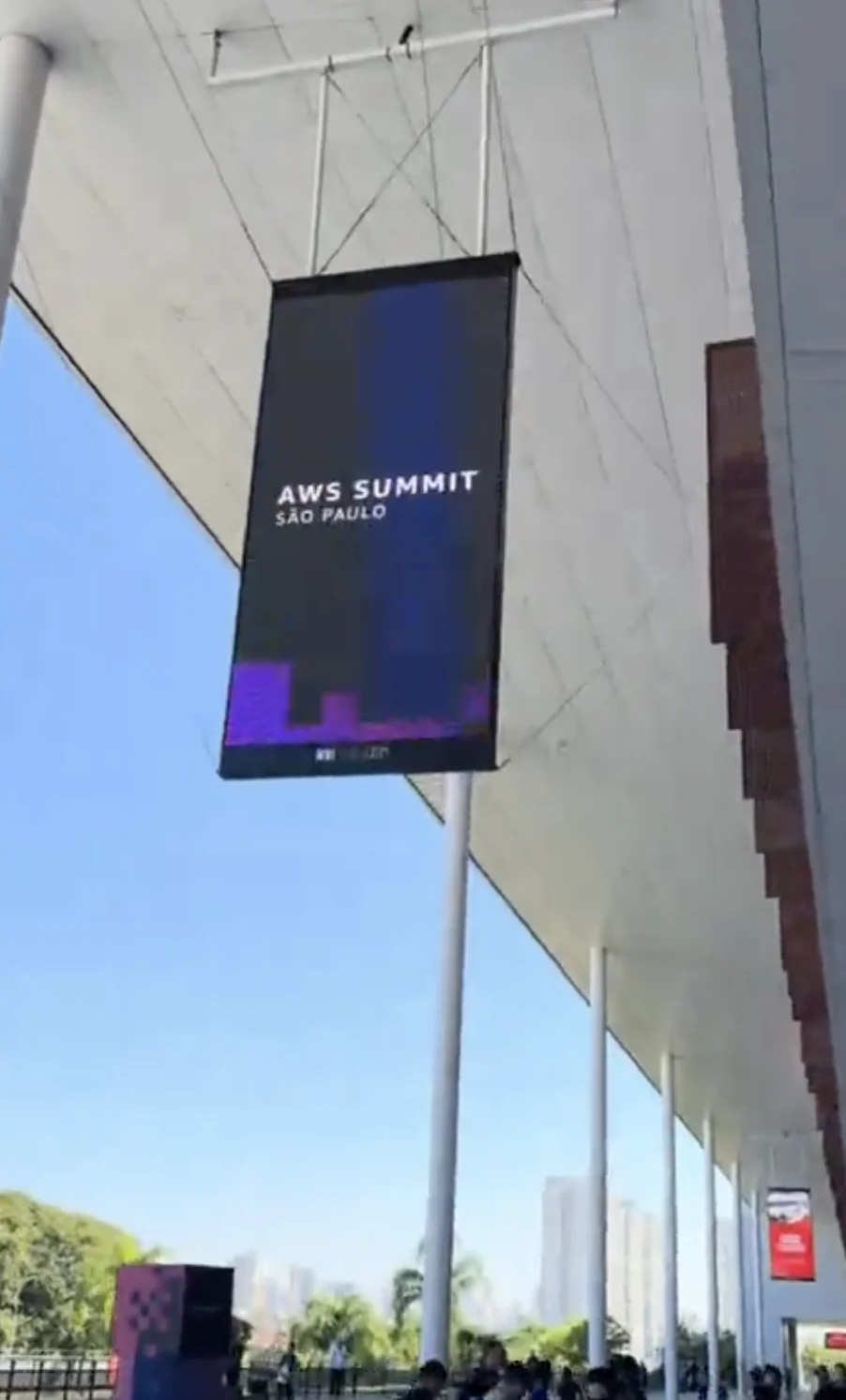
Arriving at São Paulo Expo for AWS Summit São Paulo 2026.
AWS as a business platform
The strongest theme for me was the importance of AWS as a platform for solving business and social problems, rather than as a collection of isolated cloud services.
The session Tecnologia e Inclusão: Edtechs que estão transformando a educação brought together two edtech perspectives. SoulCode Academy discussed digital education and paths into technology careers, while EduFlex Educação focused on accessibility and inclusive learning. Education is especially meaningful to me because I am working toward a PhD focused on educational games. Seeing inclusion, professional training, and cloud technology discussed together made this one of the sessions closest to my own interests.
The business impact was even more explicit in Atlético-MG: como o Galo transformou dados em +R$15M com IA na AWS. Atlético-MG and Guidance Experts presented an AI platform connected to more than R$15 million in reported profit, with applications such as dynamic pricing, churn prevention, hyperpersonalization, and generative AI. It was a clear example of cloud and machine learning work being tied to outcomes that people outside the engineering team can understand.
The Pismo case in Aurora and DynamoDB: More Performance and Lower Cost at Scale reinforced this connection from another angle. Choosing between relational and NoSQL technologies—or combining them—affects performance, resilience, and cost, all of which eventually become business decisions.
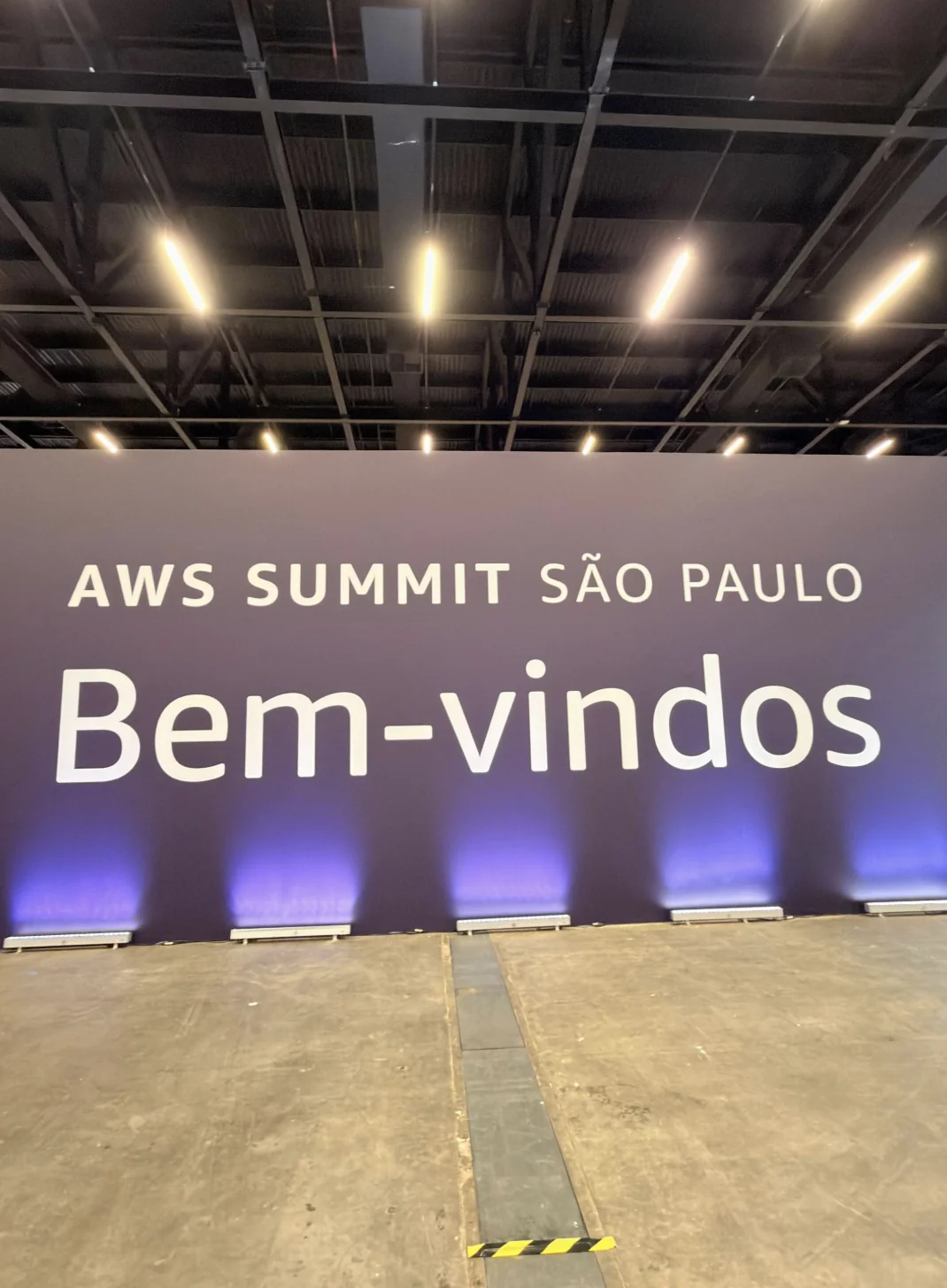
The welcome area inside the event.
Observability and operating at scale
Another important part of the event was observability. Modern cloud systems can scale quickly, but that flexibility is useful only when teams can understand what their systems are doing.
How Serasa prepares for traffic spikes discussed Kubernetes autoscaling and the challenge of responding before a sudden increase in demand affects users. Intelligent observability: reduce complexity with Amazon CloudWatch approached the same operational problem through telemetry, showing how metrics, logs, and traces can be brought together with CloudWatch and OpenTelemetry to reduce the effort required to investigate incidents.
Together, these sessions showed that elasticity and observability belong to the same conversation. Scaling infrastructure is only one part of reliability; teams also need useful signals, testing, and a clear path from a symptom to an explanation.
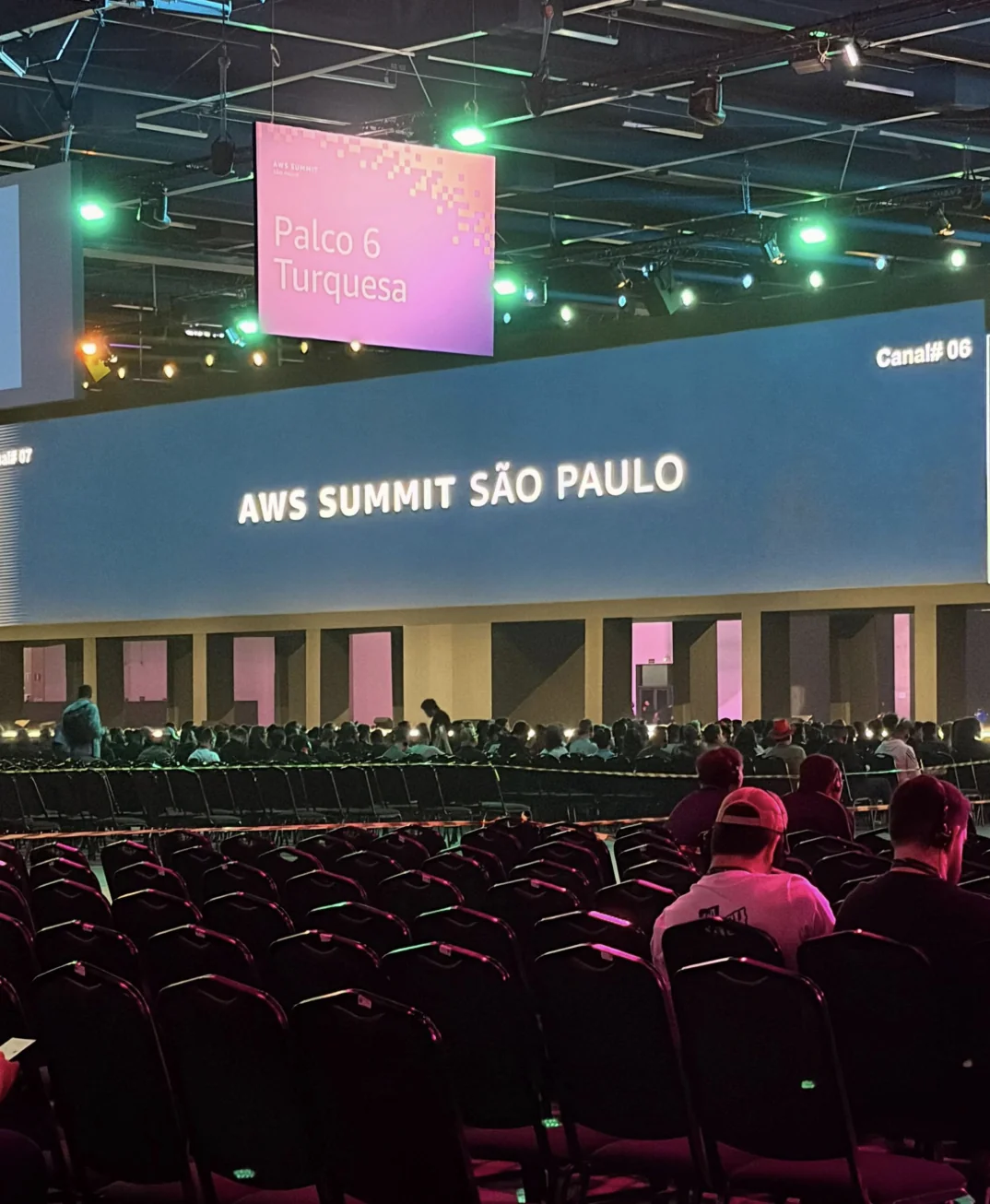
One of the Summit's stages, giving a sense of the event's scale.
AI agents, Kiro, and MCP
AI agents were present throughout the Summit. The Laura Grit Keynote framed agentic systems as part of how developers can turn ideas into working products, modernize workloads, and operate more complex environments. The keynote made it clear that AWS sees agents as a new layer in the development process, not only as chat interfaces.
I also visited the Kiro booth and received an overview of its approach to spec-driven development. Instead of moving directly from a prompt to code, Kiro can structure work into requirements, design decisions, and implementation tasks. That approach interested me because it gives the developer checkpoints where assumptions can be reviewed before an agent changes the codebase.
At the booth, I was told that one way to connect Kiro IDE with AWS is through the AWS CLI. This allows Kiro to work with AWS resources using the credentials and configuration already available in the command-line environment.
That led naturally to Model Context Protocol (MCP), another recurring subject at the event. In Advanced modeling with Amazon DynamoDB and MCP, MCP was connected to DynamoDB modeling and developer assistance. DynamoDB remains a service where good results depend heavily on understanding access patterns, so an AI-assisted workflow is most valuable when it helps expose and reason about those decisions instead of hiding them.
Machine learning from cloud to edge
Machine learning appeared in several business cases, but the clearest end-to-end technical example came from YOLO26: Real-time computer vision at the edge with AWS.
The demonstration used Amazon SageMaker AI for managed training, Amazon S3 for versioned model artifacts, and AWS IoT Greengrass for deployment to a Jetson Orin Nano. The device performed real-time inference locally, while the cloud handled training, model distribution, observability, and downstream event processing.
The most interesting part was the operational story around the model: ONNX export, TensorRT optimization, over-the-air updates, canary deployment, and automatic rollback. It showed that edge machine learning involves far more than obtaining a prediction; it also requires a reliable way to train, distribute, monitor, and update models across devices.
Final impressions
AWS Summit São Paulo is a huge event. The number of simultaneous sessions, booths, demonstrations, and activity zones means that every attendee will experience a different subset of it. It is also necessary to walk a lot: my smartwatch recorded more than 10,000 steps during the day, so comfortable shoes are a must.
For anyone trying to keep track of the seemingly endless possibilities of AWS tools, the Summit is a great opportunity. It combines broad strategic themes with customer cases and deeply technical sessions, making it possible to see both what organizations are building and how those systems work in practice.